

Views: 0 Author: Site Editor Publish Time: 2026-08-07 Origin: Site
Procurement teams and shop owners often face a frustrating scenario when comparing machine quotes. You might notice massive price discrepancies between seemingly similar "slant bed" lathes on the market. Why do two machines boast identical turning lengths but carry vastly different price tags? This common confusion plagues capital equipment planning.
The answer involves a well-kept industry secret. Many budget-friendly "slant" machines are essentially a Flat Bed CNC Lathe equipped with a bolt-on "flying wedge" saddle. Builders use this structural workaround to mimic premium designs without casting an entirely new base. This practice masks the true mechanical capabilities of the machine.
Our goal is to provide a transparent, physics-based evaluation of true slant versus flat bed architectures. We will break down how each design handles heavy cutting forces and thermal stress. You can then align your capital equipment investments exactly with your actual production requirements.
Defining success criteria forms the foundation of any profitable machining operation. You want extended tool life across every shift. You need minimal scrap rates caused by thermal deviation. Operators demand uninterrupted chip evacuation to keep cycles running. Machines must survive decades of continuous use. A truly profitable lathe delivers these outcomes consistently.
The procurement trap catches many buyers during the quoting phase. Purchasing agents often evaluate machines purely by swing capacity. They look closely at maximum turning lengths. They prioritize the initial sticker price above all else. Buyers frequently ignore the underlying casting architecture entirely. This superficial evaluation leads directly to mismatched equipment on your shop floor.
Cost versus output realities hit hard during daily operations. You might save twenty percent on initial capital expenditures. A basic Flat Bed CNC Lathe looks incredibly appealing upfront. However, hidden operational costs accumulate quickly over months of heavy production. Operators face rapid insert wear during tough cuts. They must pause cycles constantly to clear stubborn chip nests. Frequent machine downtime quickly destroys your initial purchase savings.
A traditional flat machine begins with horizontal ways. Builders cast a massive, flat iron base parallel to the floor. The cross-slide moves horizontally across this stable platform. This traditional structural definition works perfectly for manual turning operations. It provides a highly stable platform for basic, low-speed machining.
The "flying wedge" modification changes this dynamic completely. Engineers recognized the operational benefits of slanted turrets. They wanted better chip flow alongside cheaper manufacturing processes. Their engineering workaround involves bolting a wedge-shaped block directly onto the flat cross-slide. This wedge angles the turret aggressively toward the operator.
The physics of this overhang introduce significant mechanical flaws. The turret's center of gravity shifts dramatically. It pushes forward, moving entirely beyond the supporting guideways. Cutting forces no longer compress safely downward into the solid iron casting. Instead, they act as a dangerous lever. They pry relentlessly against the bolted joint. Mechanical stress concentrates intensely at the mounting bolts.
While this design has mechanical limitations, it still offers significant value. Low-volume job shops utilize these machines highly efficiently. Turning softer materials like brass and aluminum works exceptionally well on these platforms. Educational environments frequently use them to teach basic CNC programming safely. Budget-constrained setups benefit greatly from the significantly lower initial purchase price.
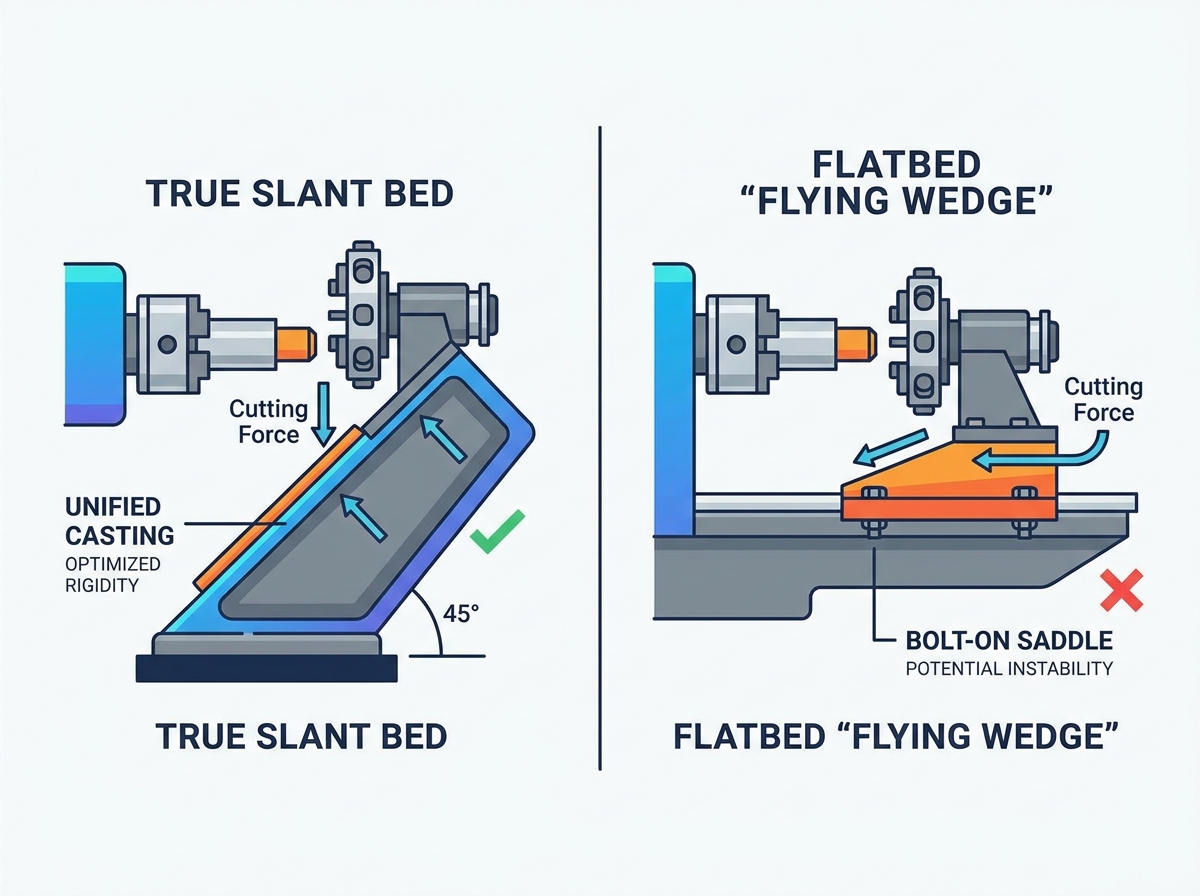
A true slant bed begins with a completely different structural definition. Builders machine the slant directly into the primary base structure. They cast the iron at specific angles from the ground up. You typically see thirty-degree, forty-five-degree, or sixty-degree inclines in the industry. The base and the slant form one solid, continuous piece of dampening cast iron.
Force distribution improves immensely with this unified design. Cutting forces push downward during heavy turning operations. They also push inward simultaneously. A true slant directs these forces exactly between the linear or box guideways. The kinematic loop remains incredibly tight. This geometry maximizes structural rigidity under extreme loads.
Thermal dynamics play a crucial role in maintaining part tolerances. Heavy machining generates immense friction and heat. Spindles run hot during extended cycles. Ball screws expand microscopically. A unified casting absorbs this heat evenly across its mass. It acts as a massive thermal sink to dissipate energy predictably. Two bolted components simply cannot match this stability. The bolted joint creates a disruptive thermal barrier.
Understanding structural differences helps you predict daily machining outcomes. We must compare these architectures across practical, real-world operational categories. Operator intervention, surface finish quality, and floor space usage all impact your ultimate profitability.
Gravity serves as your greatest asset on a true slant machine. It pulls chips naturally downward away from the cutting zone. They fall directly into the waiting chip conveyor. You have zero horizontal surfaces for dangerous bird-nesting. Stringy materials like 304 stainless steel clear effortlessly.
A wedge design struggles significantly with chip management. Chips pile up fast during aggressive material removal. They land constantly on the flat ways behind the wedge block. Operators must stop the machine frequently. They perform manual wash-downs to clear the accumulated debris. Heavy chip loads risk severely damaging the expensive way covers over time.
High dynamic stiffness changes everything regarding tool life. True slant structures reduce micro-vibrations significantly during operation. You can take heavy interrupted cuts confidently. You preserve fragile, expensive insert edges much longer. Your tooling budget decreases as a direct result.
The structural overhang on a wedge introduces microscopic chatter. You might not hear this vibration immediately during the cycle. However, it degrades surface finishes rapidly on your final parts. Tough alloys expose this mechanical weakness instantly. Materials like Inconel, Titanium, and Tool Steels require maximum rigidity to turn successfully.
Floor space dictates shop capacity and overhead costs. True slant machines typically offer a much smaller Y-axis footprint. They fit securely into cramped shop layouts. They also provide vastly superior operator ergonomics. Machinists enjoy closer, safer access to the chuck. Loading heavy billets becomes much easier on the lower back.
| Operational Feature | True Slant Bed Casting | Flat Bed "Flying Wedge" |
|---|---|---|
| Chip Flow | Excellent; gravity pulls chips directly into the conveyor. | Poor; chips pool on horizontal ways requiring manual cleaning. |
| Vibration Dampening | Superior; single-piece mass absorbs heavy interrupted cuts. | Moderate; bolted joint overhang amplifies cutting chatter. |
| Thermal Stability | High; unified iron casting dissipates heat evenly. | Variable; bolted joints create unpredictable thermal expansion. |
| Shop Footprint | Compact; slant reduces overall machine depth requirements. | Large; horizontal cross-slide extends the Y-axis footprint. |
The marketing ambiguity surrounding CNC lathes confuses many seasoned buyers. Some manufacturers use highly misleading language in their promotional materials. They label flying wedge models proudly as "slant bed" machines. They rely entirely on the visual angle of the exterior sheet metal. They hope buyers completely ignore the underlying cast iron structure.
Buyers need strong, proactive inspection tactics before making a purchase. Do not rely on glossy brochures or external cosmetic designs.
If the X-axis servo sits horizontally behind the machine, beware. It should match the slant angle exactly. If it sits flat, you are looking at a modified wedge. Furthermore, true slant castings weigh substantially more due to their solid structural mass.
Maintenance risks escalate predictably over time with wedge designs. Heavy daily use stresses the machine intensely. Coolant ingress constantly threatens the vulnerable bolt-on wedge joint. Moisture seeps microscopically between the two metal plates. Micro-shifting occurs frequently after years of heavy interrupted cuts. You risk losing your geometric alignment permanently due to fretting wear.
Selecting the correct architecture depends entirely on your specific production demands. A mismatch destroys margins, while the right choice accelerates throughput.
Shortlisting a Flat Bed CNC Lathe makes perfect financial sense in specific scenarios. Choose this architecture carefully based on these operational realities:
Shortlisting a true slant bed requires entirely different operational parameters. Choose this robust architecture if your shop matches these demanding profiles:
Your next steps dictate your ultimate financial success. Calculate the actual cost of lost tool life thoroughly. Measure the true cost of chip-clearing downtime over a standard five-year period. Weigh these ongoing operational expenses directly against the initial price premium. A rigid machine often pays for itself rapidly through uninterrupted production.
Neither machine architecture is inherently flawed. They simply serve entirely different manufacturing purposes. Applying a flat bed flying wedge to a true slant application remains dangerous. It represents a costly engineering mismatch that drains profits through hidden downtime.
We urge decision-makers to look deeper into their equipment quotes. Prioritize foundational casting geometry during your evaluation phase. Spindle specifications and advanced control systems certainly matter greatly. However, the raw iron foundation ultimately determines your actual machining capability under load.
Contact your engineering team today to review your current production strategy. Ask experts for a rigid machine capability assessment. Base this critical evaluation on your most difficult specific part prints. Ensure your next capital investment aligns perfectly with your long-term production goals.
A: No, the industry technically classifies it as a modified flat bed. While the turret sits at an angle, the underlying cast iron ways remain completely horizontal. Builders achieve the slant by bolting a wedge block onto a flat cross-slide. True slant machines feature a single-piece casting angled directly from the floor.
A: Yes, but primarily during light cuts and in stable temperature environments. A flat bed struggles to maintain those tight tolerances under heavy loads. The bolted wedge introduces mechanical overhang. This causes microscopic chatter and unpredictable thermal expansion when processing tough materials over long shifts.
A: Builders typically use 30, 45, or 60 degrees. A 30-degree bed offers excellent operator ergonomics for heavy part loading. A 60-degree bed provides flawless gravity-assisted chip drops but makes manual loading harder. The 45-degree bed serves as the industry sweet spot, perfectly balancing chip evacuation with operator accessibility.
A: Heavy single-piece castings require stable, reinforced concrete floors to prevent shifting. While you might not need a completely custom poured foundation pit, you must verify your concrete thickness. True slant machines carry immense concentrated mass. A thin shop floor will crack, destroying the machine's precise geometric leveling.

