

Views: 0 Author: Site Editor Publish Time: 2026-08-01 Origin: Site
Choosing your machine bed architecture is never just a matter of personal preference. It serves as a foundational variable dictating part precision, tool life, and shop floor throughput. A poor configuration restricts your operational ceiling before you even load the first workpiece into the chuck. You must view this structural choice as the anchor for your entire machining strategy.
Historically, flatbed designs stood as the undeniable industry standard. You would see them dominating manual operations and early CNC setups everywhere. Today, however, the Slant Bed Lathe has clearly taken over as the modern default for advanced manufacturing. Why did this shift happen? We need to look past basic definitions to find the real answer.
This article provides a deep structural and economic breakdown of both platforms. You will discover exactly how geometry impacts cutting forces, thermal stability, and automation readiness. Our goal is simple. We want to help production managers and shop owners confidently justify their next machine tool investment.
You need to understand the physical bones of these machines. Machine tool geometry directly controls how physical forces travel during aggressive cutting. A machine framework behaves like a tuning fork. It will either absorb energy gracefully or amplify harmful vibrations.
Traditional flatbed designs align the X and Z axes horizontally. They run completely parallel to the shop floor. This horizontal orientation forces operators to look down directly into the cutting zone. These machines typically rely heavily on traditional box ways. You will find they use immense cast-iron mass to absorb cutting vibrations.
Engineers designed them for extreme load-bearing capabilities. Heavy workpieces sit securely across a wide, flat saddle. The center of gravity remains very low to the ground. This setup handles massive, oversized parts easily. However, the horizontal layout creates unique physical constraints. Gravity does not help remove cut material or fluid. Everything rests on the flat horizontal plane, demanding more manual operator intervention.
Modern CNC turning centers typically adopt an inclined carriage design. You will most commonly see bed angles cast at 30, 45, or 60 degrees. This slant pushes the spindle centerline backward. It fundamentally changes how the entire machine absorbs kinetic energy.
You must understand the critical difference between a "true slant bed" and a wedge design.
The bolt-on wedge approach introduces a mechanical joint. Joints inherently reduce structural stiffness. True slant configurations better resist torsional twisting. They handle aggressive spindle speeds without chattering. They deliver superior dimensional stability during roughing operations. You get a much stiffer platform overall.
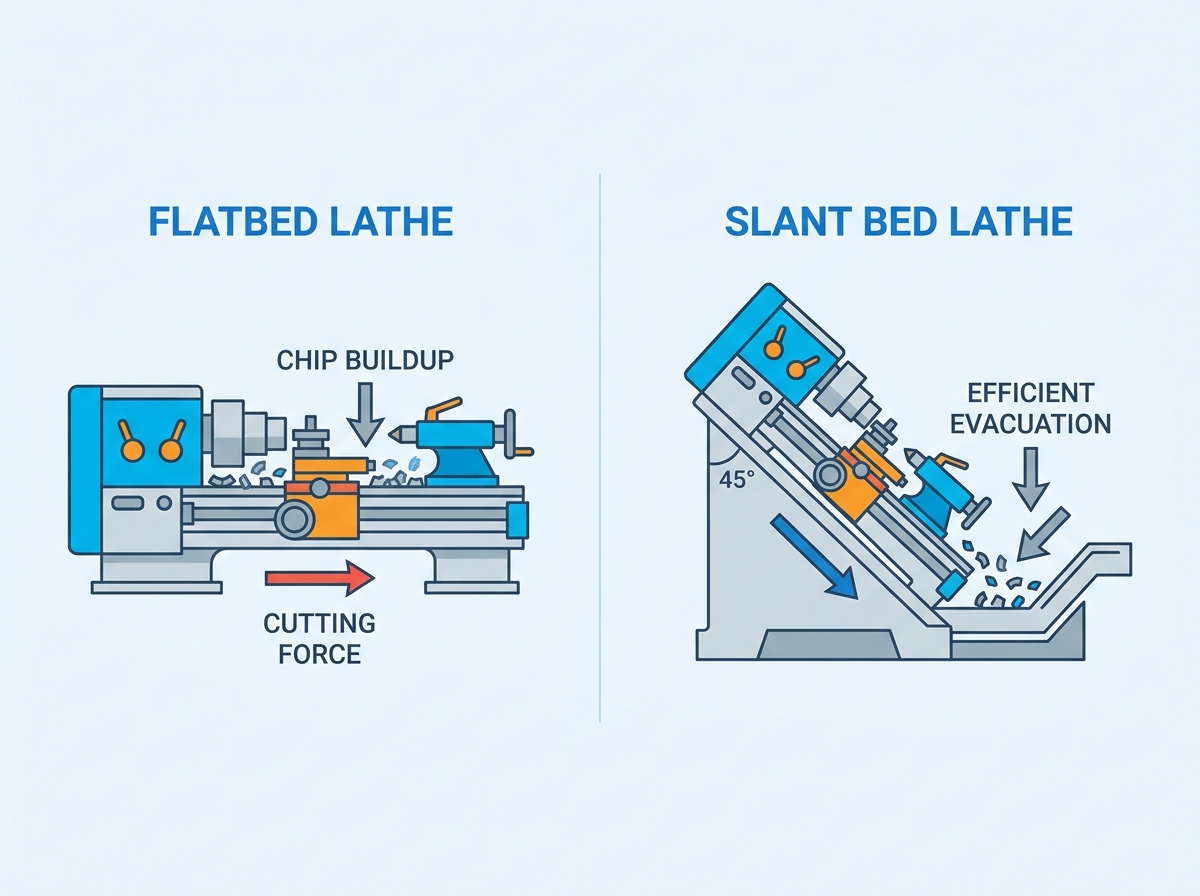
Let us compare how these two geometries perform on the shop floor. We will evaluate them across four crucial operational metrics. You will see how physics plays a role in everyday machining.
Managing metal chips remains a constant battle in any machine shop. Poor chip control destroys cutting tools and ruins part finishes.
Flatbed: Chips naturally accumulate directly on the horizontal ways. Gravity keeps them trapped right below the cutting zone. You must frequently pause operations to clear this buildup manually. If you ignore it, stringy chips risk wrapping around your workpiece. They also block coolant nozzles. Starving a tool of coolant will degrade your surface finishes instantly.
Slant Bed: The inclined geometry uses gravity to its advantage. Chips fall away from the cutting tool immediately. They slide down the incline directly into a chip pan or automated conveyor. Coolant flows naturally downward without pooling. This self-cleaning environment enables true unattended and automated machining. You rarely need to stop the spindle to clear debris.
Machine rigidity directly dictates your surface finish and tool life. You cannot machine precise parts on a flexible platform.
Flatbed: Cutting forces push horizontally, parallel to the flat ways. The machine relies purely on its sheer weight to resist these forces. During heavy or high-speed cuts, this horizontal force vector can induce subtle micro-vibrations. Vibration is the ultimate enemy of machining precision. It causes premature insert failure and chatter marks.
Slant Bed: The spindle centerline and turret sit at a precise angle. This geometry directs cutting forces downward. It pushes the load directly into the heaviest, thickest part of the machine casting. This downward vector naturally dampens vibration. Tools experience significantly less chatter. You get longer insert life and mirror-like finishes.
Temperature fluctuations silently destroy part tolerances. Heat causes metal to expand, changing where the tool sits relative to the workpiece.
Flatbed: Hot metal chips sit directly on the flat horizontal ways. They transfer intense heat right into the machine casting. This causes localized thermal expansion. Over a long shift, your Z-axis can physically grow. Your tight tolerances will drift. This drift requires constant manual offset adjustments from your operators.
Slant Bed: Since chips fall away instantly, they take the heat away immediately. They do not rest on critical guideways. The machine maintains a much more stable internal temperature. You can hold tighter tolerances across continuous, multi-shift production runs. Thermal drift becomes a non-issue.
Floor space and operator comfort impact daily profitability. A comfortable operator makes fewer setup mistakes.
Flatbed: These machines require a surprisingly large physical footprint. Furthermore, the ergonomics are notoriously poor. Operators must reach far over the wide flat ways. Setting up heavy chucks or measuring parts causes back strain. Reaching the spindle center requires awkward physical positioning.
Slant Bed: The angled design significantly reduces the Z-axis depth. You save valuable shop floor space. Additionally, the slanted doors allow operators to stand much closer to the spindle. You get highly ergonomic access. Part inspection and tool changes become faster and physically safer for your machinists.
| Evaluation Metric | Flatbed Architecture | Slant Bed Architecture |
|---|---|---|
| Chip Evacuation | Manual clearing often required; chips pool on ways. | Gravity-fed into conveyor; ideal for automation. |
| Force Distribution | Forces push parallel to bed; relies on raw mass. | Forces push down into the casting; superior dampening. |
| Thermal Stability | High heat transfer from resting chips; prone to drift. | Low heat transfer; chips fall away quickly. |
| Ergonomics | Operator must reach far over the wide machine bed. | Close, ergonomic access to the spindle and chuck. |
Beyond basic specifications, you must consider the reality of daily operation. Certain hidden risks only become apparent after installation. Planning for these risks prevents future bottlenecks.
Machining complex parts requires versatile tooling setups. You need space to maneuver these tools safely.
A flat orientation severely limits how many tools you can pack into a turret. Heavy, multi-station turrets risk colliding with the tailstock or the chuck jaws. Space gets very cramped very quickly. You often have to leave certain turret stations empty to avoid crashes during tool changes.
The slant angle changes this dynamic entirely. It provides a much larger working envelope. You can easily install massive, heavy-duty turrets. You can integrate extensive live tooling options without interference. The geometry naturally creates better clearance zones. It frees you to tackle complex geometries in a single setup. You can safely deploy long boring bars alongside radial live tools.
Machine ways are the precision veins of your equipment. Damaged ways guarantee bad parts.
Flatbed guideways sit directly below the cutting action. They remain highly vulnerable to chip scoring. Even using protective wipers, fine abrasive particles find their way underneath the saddle. This causes premature wear. It degrades absolute accuracy over time. Rebuilding scraped box ways is incredibly expensive and time-consuming.
In contrast, manufacturers typically position slant bed linear guideways above and behind the primary cutting zone. Gravity pulls damaging debris away from these critical surfaces. The ways stay much cleaner. Telescopic covers function much more efficiently on an incline. This strategic positioning drastically reduces your long-term maintenance burdens.
Manufacturers increasingly rely on robots and automated bar feeders. Labor shortages demand unattended machining solutions.
You take a massive risk pairing heavy automation with a flatbed machine. Continuous bar feeding generates massive chip volumes. On a flat horizontal surface, these chips build up rapidly. A sudden chip nest can completely blind robotic vision systems. It can block proximity sensors on your chuck. It will eventually bottleneck your entire automated cell, causing unexpected alarms.
A Slant Bed Lathe eliminates this specific bottleneck. The continuous, gravity-assisted chip flow supports non-stop operation. You can run "lights-out" manufacturing shifts confidently. The machine simply clears itself. This keeps your robotic loaders moving efficiently without human intervention.
You need clear criteria to make a confident purchasing decision. Let us look at specific operational profiles. Aligning your machine choice with your business model ensures profitability.
Despite modern advancements, flat designs still dominate specific manufacturing niches. They offer distinct physical advantages for certain applications.
Consider this architecture if you match these criteria:
They excel when sheer size and raw swing capacity matter most. You get immense workholding flexibility for awkward, non-standard shapes.
High-performance shops lean heavily toward slanted geometries. The speed and precision benefits scale beautifully in production environments.
You should prioritize this configuration under these conditions:
They shine when speed, precision, and repeatability drive your daily profitability. You gain a compact, high-output production center.
Never buy a machine based entirely on marketing brochures. You must validate the performance claims. We strongly recommend requesting formal time studies from your machine tool distributors. Ask them to perform actual test cuts using your specific part materials. You need to quantify the actual cycle time differences. Measure the surface finish variations between both architectures. Hard data protects your capital investment and prevents buyer's remorse.
Your ultimate choice clearly comes down to your specific application requirements. Flatbeds continue to win on raw size capacity and lower entry prices. They handle massive, heavy-duty repair work beautifully. Conversely, slant beds definitively win on speed, precision, and automation capability. They provide the thermal stability and dynamic rigidity required for modern high-volume manufacturing. Take immediate action to audit your current production bottlenecks. Look closely at your most challenging part prints. We encourage you to consult directly with a dedicated applications engineer. They can evaluate your specific shop floor constraints and help map out a highly precise integration strategy.
A: The 45-degree angle stands as the undisputed industry standard. It offers the perfect balance between operator ergonomics and structural rigidity. However, builders also offer 30-degree and 60-degree variations. You will typically see these alternative angles on highly specialized heavy-duty machines or ultra-compact turning centers where space is strictly limited.
A: Yes, it absolutely can for single parts in a strictly controlled environment. However, a flatbed struggles to maintain that extreme consistency over a full production shift. Hot chips resting on the horizontal ways induce thermal drift. This heat transfer forces operators to make frequent manual offset adjustments.
A: While the initial purchase price is higher, maintenance demands frequently balance out. The slanted design naturally protects delicate linear guideways from abrasive chip scoring. You experience significantly less downtime from chip-related jams. This built-in protection extends the lifespan of critical machine components, offsetting the initial acquisition costs.

