

Views: 0 Author: Site Editor Publish Time: 2026-08-13 Origin: Site
Scaling metalworking production creates constant tension on the shop floor. You must constantly balance the demand for tight-tolerance precision against strict capital expenditure limits. Available floor space constraints often complicate this crucial balancing act even further. A modern CNC Vertical Machining Center acts as the primary driver of your production capacity, rather than just another standard piece of equipment. Manufacturers rely on it heavily for single-setup jobs, heavy plate-based operations, and highly intricate mold-making tasks. In the sections below, we will evaluate these core machine features strictly through a commercial lens. You will discover exactly how to match specific spindle dynamics and guideway architectures to your daily operations. This structured guide ensures you achieve the optimal machine-to-application fit for maximum operational output.
You must differentiate between standard marketing specifications and true performance indicators. Some features look impressive in brochures but fail to improve actual cycle times. We focus here on the mechanical systems dictating long-term repeatability and pure material removal rates.
The spindle serves as the heartbeat of your machine. Matching spindle characteristics to your primary workpieces determines overall profitability. High-speed spindles operating at 12,000 RPM or higher excel in fast material removal. These direct-drive units dominate aluminum and plastic machining applications. They allow rapid feed rates without sacrificing surface finish quality.
Conversely, aerospace and energy sectors demand different capabilities. You need high-torque, geared-head spindles for cutting titanium and Inconel. Geared spindles multiply low-end torque. This prevents spindle stall during heavy roughing passes on hardened alloys.
Spindle Dynamics Chart
| Spindle Type | Typical RPM Range | Primary Advantage | Ideal Target Materials |
|---|---|---|---|
| Direct Drive | 12,000 - 24,000 | High surface speed, low vibration | Aluminum, Plastics, Brass |
| Belt Drive | 8,000 - 12,000 | Balanced cost and performance | Mild Steels, Cast Iron |
| Geared Head | 4,000 - 8,000 | Massive low-end cutting torque | Titanium, Inconel, Tool Steels |
The machine's axis movement relies on its underlying guideway structure. Linear guide ways utilize rolling ball or roller bearings. They provide exceptionally fast rapid traverse rates. Shops running high-volume, lighter cuts prefer linear ways to minimize non-cutting time.
Box ways feature solid, flat-bearing surfaces sliding against each other. They offer superior vibration dampening and massive rigidity. You should select box ways for heavy, interrupted cuts on hardened tool steels. The increased friction limits top speeds but maximizes cutting stability.
Tool change mechanics directly impact your chip-to-chip times. Umbrella-style ATCs cost less but move slower. Swing-arm ATCs stage the next tool simultaneously during the cutting cycle. This mechanical advantage shaves seconds off every single tool change. These saved seconds compound into massive annual cycle efficiency gains.
Control systems require equal scrutiny. Processor speed matters immensely for complex 3D contouring. Low block processing times prevent the machine from starving for data. Fast controls read G-code thousands of blocks ahead. This ensures smooth interpolations rather than jerky axis movements.
Integrating the right machinery directly impacts your shop floor's bottom line. Business leaders must view technical capabilities as distinct commercial advantages. Vertical machines deliver specific economic benefits for modern production environments.
VMCs typically cost 15-30% less than equivalent HMCs. This lower initial investment accelerates your payback period significantly. A smaller upfront capital commitment frees cash flow for tooling and software upgrades.
Vertical orientation naturally consumes less expensive floor space. You can easily achieve higher machine density per square foot. More spindles running in a smaller footprint maximizes your facility's revenue potential.
The vertical layout provides operators superior visibility during machining. Manual clamping becomes much easier on a flat table. These ergonomic advantages drastically reduce setup times for high-mix, low-volume (HMLV) production schedules. Operators can verify tool paths visually before pressing cycle start.
Prototyping demands extreme operational flexibility. VMCs remain vastly easier to program and set up for one-off parts. Engineering teams often run short batches vertically first. Once proven, they transition the processes to automated horizontal cells for mass production.
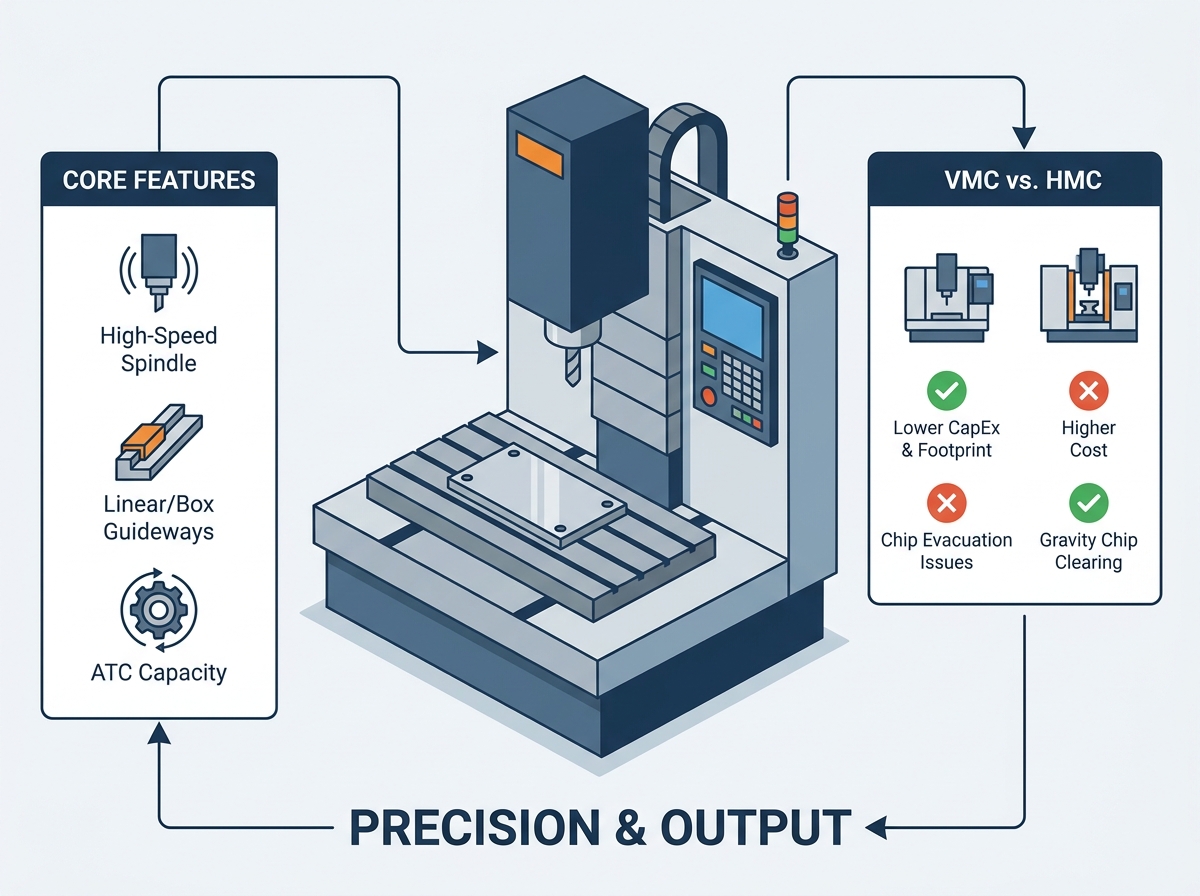
We must analyze where these machines deliver maximum value based on part geometries. Evidence-based application matching prevents costly misallocations of capital. Different industries leverage vertical architecture for highly specific reasons.
Tool, die, and mold making rely entirely on this technology. The vertical spindle provides unmatched top-down access into deep cavities. CNC Vertical Machining Center rigidity allows for heavy roughing of block steel. Afterward, the same machine performs fine surface finishing on intricate 3D molds.
Aerospace manufacturers utilize vertical setups for structural components. They frequently machine brackets, bulkheads, and housings from relatively flat stock. Complex profiling on aluminum plate stock matches perfectly to high-speed vertical dynamics. Operators can clamp large aerospace panels directly to the expansive work table.
Medical device manufacturing requires extraordinary precision and surface finish. Shops mill orthopedic implants and surgical instruments daily. These shops often utilize ultra-high-speed spindles to accommodate tiny endmills. The vertical orientation helps operators monitor delicate features during proving runs.
We must also acknowledge the limitation reality. VMCs fall short when tackling high-volume, multi-sided prismatic parts. Machining five sides of a block vertically requires multiple setups. Multi-setup processes introduce dangerous tolerance stacking inaccuracies. A 4-axis HMC or a dedicated 5-axis machine serves these specific parts much better.
Floor managers need a direct, objective comparison framework. Misunderstanding machine geometry advantages leads to severe production bottlenecks. You must evaluate part handling and chip management objectively.
Chip evacuation presents a major divergence between the two architectures. VMCs suffer from a "chip recutting" risk. Gravity naturally keeps heavy chips sitting inside deep pockets. HMCs leverage gravity to their advantage. Chips simply fall away from the horizontal workpiece. This natural clearing prevents premature tool wear.
Part handling dictates setup efficiency. VMCs win easily on heavy, flat parts. Operators can simply drop massive plates onto the table via overhead crane. HMCs win on tombstone fixturing. You can mount dozens of small parts on a single horizontal tombstone.
Automation readiness also differs fundamentally. You can certainly automate vertical machines using robotic arm loading. However, HMCs are natively designed for pallet pools from the ground up. Horizontal machines support lights-out manufacturing much more seamlessly.
VMC and HMC Decision Matrix
| Evaluation Criteria | Vertical Machining Center | Horizontal Machining Center |
|---|---|---|
| Ideal Workpiece | Large plates, single-sided parts | Multi-sided prismatic parts |
| Chip Evacuation | Requires high-pressure coolant | Excellent gravity-assisted clearing |
| Fixture Loading | Crane-friendly flat table | Complex tombstone setups |
| Native Automation | Robot loading compatible | Built for pallet pool integration |
Operators and maintenance managers face specific challenges upon installation. Understanding these risks before the machine hits the shop floor prevents disastrous delays. Proper planning mitigates these common operational hurdles.
Thermal deformation destroys tight tolerances over long shifts. Continuous high-speed operation generates massive heat within the casting. You must prioritize spindle chillers for high-tolerance applications. Advanced thermal compensation software monitors structural temperatures. It dynamically adjusts axis positioning to counteract physical metal expansion.
Coolant management poses significant daily challenges. Chip pooling in deep pockets ruins expensive carbide tooling rapidly. You must invest in high-pressure through-spindle coolant (TSC). TSC blasts chips out of blind holes effectively. This upgrade extends tool life and guarantees better surface finishes.
Operator skill gaps often surprise management teams. Transition costs include training staff on new proprietary control interfaces. Advanced CAM software integration requires dedicated programming time. You must allocate sufficient training hours to reach full production speed.
Procurement and engineering teams need actionable steps for vendor selection. Randomly comparing brochures leads to poor investments. Follow a structured approach to finalize your equipment choices.
VMCs remain the absolute backbone of precision manufacturing worldwide. They dominate flat-work, heavy mold making, and high-mix production schedules. Their highly favorable cost-to-performance ratio makes them indispensable for both job shops and major OEMs. You secure immense cutting capability without the staggering infrastructure costs of horizontal automation.
The "best" machine on the market simply does not exist in a vacuum. The right choice is tailored explicitly to your specific material requirements. You must account for your complex part geometries and baseline operator capabilities. Aligning these factors guarantees long-term machining success.
Never issue a purchase order based on specifications alone. Encourage your buyers to request live test cuts immediately. Demand comprehensive time studies on your own specific CAD models from short-listed vendors. This empirical proof ensures the quoted cycle times match reality.
A: A high-quality machine easily lasts 10 to 15 years in production. Rigorous preventative maintenance extends this lifespan significantly. Heavy roughing applications degrade ball screws faster than light aluminum milling. Proper lubrication and prompt crash recovery ensure decades of accurate service.
A: Yes, you can upgrade standard 3-axis machines easily. You install aftermarket rotary tables or trunnions onto the main table. However, you must ensure the machine includes pre-wired 4th or 5th axis drives. Retrofitting drives later costs significantly more money.
A: Yes, TSC represents a mandatory investment for most shops. It forces high-pressure coolant directly through the cutting tool. This completely clears chips during deep hole drilling. It drastically extends tool life and prevents catastrophic tool breakage in gummy aluminum.
A: You must allocate substantial room beyond the machine's static footprint. Operators require three feet of clearance for daily loading access. Chip conveyors need extended space for external collection bins. You must also account for fully swinging maintenance doors and forklift pathways.

