

Views: 0 Author: Site Editor Publish Time: 2026-08-19 Origin: Site
Machine shops evaluating a new milling asset often face a strict binary choice. You must select either the proven affordability of a Vertical Machining Center (VMC) or the advanced multi-sided capability of a Universal Machining Center (UMC). Making an incorrect choice often results in bottlenecked cycle times. It can also lead to wasted capital expenditure. This crucial decision dictates your future tooling strategies. It shapes CAM software requirements and influences operator training demands. UMCs promise impressive "done-in-one" efficiency for complex parts. Meanwhile, VMCs remain the reliable backbone for straightforward flat geometries. This guide breaks down the core structural differences and operational trade-offs between UMCs and VMCs. We will also identify exactly when a CNC Horizontal Machining Cente might actually be the optimal alternative for your production floor. You will learn how to align specific machine types directly to your shop's production goals. We provide a clear framework to help you navigate this significant equipment investment.
We must first examine how these machines are physically built. Their underlying architecture defines their ultimate cutting capabilities. The spindle orientation dictates how the cutting tool approaches the raw material.
A VMC utilizes a standard top-down approach. The spindle moves vertically along the Z-axis to reach the workpiece. Your raw material sits flat on a fixed table. Operators clamp it securely using traditional methods. The machine moves the table along the X and Y axes. This simple kinematic structure handles flat plates and single-sided features perfectly.
In contrast, a UMC introduces complex rotational movement. The spindle or the table tilts and rotates during operation. Builders typically use trunnion tables or articulating heads to achieve this motion. This rotation grants the spindle access to five distinct sides of the part. You can machine these sides without opening the doors for manual repositioning. This capability defines the "universal" aspect of the machine.
You must also consider physical work envelope limitations. UMCs often sacrifice overall X and Y travel size. Builders shrink the linear travels to fit the complex rotary table inside the machine footprint. This design severely limits your maximum part size. Furthermore, you face spindle interference risks on UMCs. When the trunnion tilts to extreme angles, the bulky spindle housing can crash into the table. You must simulate toolpaths carefully to avoid these costly collisions.
Standard 3-axis VMCs offer immense structural rigidity. They handle heavy Z-axis plunging operations exceptionally well. The fixed table supports massive workpieces securely against cutting forces. Conversely, a 5-axis UMC trunnion setup introduces potential deflection. The moving joints and rotary bearings create inherent structural weak points. Under heavy cutting loads, you might experience chatter or poor surface finishes. You must balance the need for multi-sided access against pure cutting strength.
| Feature | VMC (Vertical Machining Center) | UMC (Universal Machining Center) |
|---|---|---|
| Spindle Approach | Top-down (Z-axis) | Variable angle (multi-axis) |
| Part Positioning | Fixed flat table | Tilting/rotating trunnion or head |
| Inherent Rigidity | Extremely high | Moderate to high (depends on tilt) |
| Interference Risk | Low (mostly Z-depth limits) | High (spindle body vs. trunnion) |
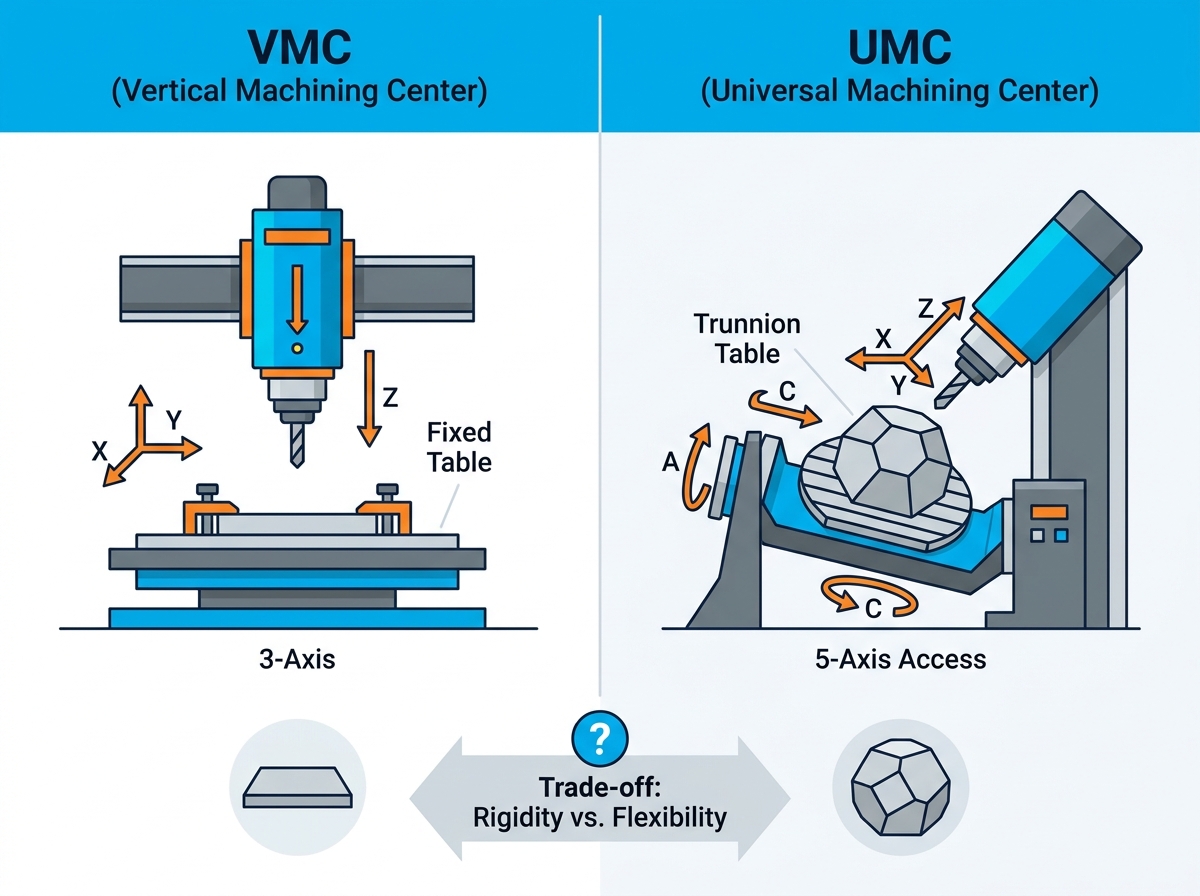
You must evaluate your specific production goals before selecting a machine. Different part profiles demand entirely different machining strategies. Let us explore the metrics determining the correct choice.
We measure part complexity primarily by manual setup counts. Count how many times an operator must stop the machine to move the part. Every manual intervention pauses production and introduces potential errors. If a specific part requires three or more manual setups on a VMC, you should strongly evaluate a UMC. The massive labor savings easily justify the switch. "Done-in-one" machining reduces idle time drastically. Your operators can focus on quality control instead of constant part flipping.
Job shops often handle high-mix, low-volume orders daily. They produce complex aerospace brackets or precision medical components. These specific parts demand tight true-position tolerances across multiple angled faces. UMCs excel in these exact environments. They handle frequent changeovers efficiently because the fixture rarely moves.
However, VMCs shine brightly in low-mix, high-volume environments handling simpler shapes. They efficiently process simple geometries like flat cover plates or simple extrusion profiles. Cycle times here depend heavily on pure feed rates and heavy cutting capabilities. They do not depend on frequent setup changes. You maximize profitability by keeping the spindle load high.
Manual part flipping introduces significant human error. Each new clamping operation shifts the zero point slightly. These tiny physical shifts create tolerance stack-up across multiple operations. Eliminating manual flips via a UMC directly reduces this specific risk. You hold much tighter relationships between different machined faces. The machine handles the rotation automatically and accurately. You produce fewer scrapped parts and improve overall yield.
Sometimes, neither a VMC nor a UMC fits the job perfectly. You might need a completely different structural approach to conquer specific production bottlenecks.
Deep pocket machining reveals a major physical flaw in vertical spindles. Both UMCs and VMCs fight gravity constantly. Chips pool rapidly at the bottom of the cut. Tools recut these trapped chips continuously. This recutting causes premature tool wear and degrades surface finishes.
We introduce the CNC Horizontal Machining Cente as the ultimate solution for heavy material removal. Think of massive cast iron components or large structural aerospace frames. The horizontal spindle orientation allows gravity to pull chips straight down instantly. Chips flow effortlessly away from the critical cutting zone. This natural evacuation allows for much more aggressive feed rates.
Standard dual-pallet systems transform production speeds completely. Horizontal machines typically feature built-in automated pallet changers. Operators load raw material securely onto one pallet outside the machine. Simultaneously, the spindle aggressively cuts a different part inside the enclosure. This parallel workflow drives overall spindle utilization skyward. Standard VMCs often hover around 40% to 50% spindle utilization. A CNC Horizontal Machining Cente easily pushes this critical metric past 85%. You generate revenue continuously without loading pauses.
Horizontal centers also accommodate massive tombstone fixtures perfectly. These tall, multi-sided towers hold dozens of parts per cycle. You mount identical parts firmly on all four vertical faces. This batch method contrasts sharply against the single-part focus of a typical UMC. You can finish massive batches automatically overnight. Operators intervene much less frequently, allowing them to manage multiple machines simultaneously.
Adopting new machine architecture brings hidden technical hurdles. You must prepare your team for these specific operational shifts.
Workholding requirements differ wildly between machine types. VMCs utilize standard, low-cost mechanical vises. You can bolt them directly to the machine T-slots. They hold simple flat stock securely and cheaply. UMCs demand much more complex gripping solutions. You usually need specialized zero-point clamping systems. Dovetail fixtures become necessary to grip a minimal amount of raw material securely. 5-axis self-centering vises elevate the part off the table. This crucial elevation provides enough clearance to avoid spindle collisions during extreme tilt maneuvers. These specialized fixtures represent a significant upfront financial investment.
Transitioning from a VMC to a UMC forces immediate software upgrades. Basic 3-axis CAM packages simply cannot handle the new kinematic movements. You must upgrade to systems capable of continuous 5-axis or 3+2 toolpaths. Furthermore, you absolutely need robust machine simulation software. Simulating the exact machine kinematics prevents catastrophic physical crashes. Writing and proving the correct post-processor also requires expert programming skills. Do not underestimate this digital transition.
Moving operators from a 3-axis VMC to a 5-axis UMC presents human challenges. The same applies when transitioning to a multi-pallet horizontal system. Your machinists require significant technical upskilling. They must master advanced setup probing routines to find part centers accurately. They need to thoroughly understand tool center point control (TCPC). They must confidently utilize dynamic work offsets (DWO). These advanced concepts do not exist in basic 3-axis machining. You must budget adequate time for comprehensive training programs.
You need a structured method to finalize your capital equipment choice. Follow these specific steps to evaluate your true operational needs accurately.
Here is a detailed, step-by-step evaluation process:
You must evaluate your current workforce capabilities alongside these technical metrics. Make sure your team can successfully support the new technology. A high-end machine sits idle if no one can program it correctly. Assess your local dealer support network. Fast service response times remain critical to keeping advanced machinery running profitably.
We can summarize this complex equipment decision into a few highly actionable points. VMCs remain the safest, most reliable bet for flat, 3-axis work. They offer unmatched inherent rigidity for simple, heavy geometries. However, UMCs serve as massive problem-solvers for complex, multi-sided precision parts. They eliminate repetitive manual handling and drastically reduce scrap rates.
Furthermore, you must look beyond these two basic options for true high-volume, continuous production. Evaluating a CNC Horizontal Machining Cente is a necessary step before finalizing any capital equipment purchase. They dominate heavy material removal tasks and master automated pallet workflows effortlessly.
We strongly advise you to partner directly with an experienced applications engineer. Run a thorough time study on your most complex, highest-margin part. Compare the simulated cycle times and exact setup reductions across all three machine configurations. This strict data-driven approach ensures you invest confidently in the right spindle for your future business growth.
A: Yes, you can add a 4th or 5th-axis rotary table to a 3-axis VMC. This modification provides trunnion-like capabilities. However, it significantly sacrifices Z-axis clearance. It also lacks the inherent rigidity and precision of a purpose-built UMC.
A: Generally, yes. The term "Universal" implies the ability to reach five sides of a part. Machines achieve this either through 3+2 positional machining or full 5-axis simultaneous contouring operations.
A: Horizontals feature massive cast iron bases and heavier overall construction. They include built-in pallet changers and advanced automated chip management systems. These complex components raise the initial price but significantly lower your cost-per-part at high production scales.
A: VMCs typically boast lower maintenance costs. They rely on simpler kinematics and feature fewer axes of motion. UMCs and horizontals demand stricter geometric alignments and frequent maintenance of complex rotary axes to hold tight tolerances.

