

Views: 0 Author: Site Editor Publish Time: 2026-08-25 Origin: Site
Cutting tool sharpness directly dictates lathe surface finish, dimensional accuracy, and overall spindle load. A dull edge introduces severe vibration into the cut. It ruins tight part tolerances and places unnecessary strain on expensive machine components. However, many shops still rely entirely on reactive tool replacement. They discard tools rather than establishing proactive maintenance routines. This approach burns through tooling budgets quickly. It also halts production lines while operators wait for new inserts or external sharpening services.
Shifting to in-house cutting tool maintenance gives you total control over tool availability. In this article, we provide a vendor-neutral framework to navigate this transition smoothly. You will learn how to evaluate, shortlist, and implement a Lathe Tool Grinder based on your specific shop volume and precision requirements. We cover everything from evaluating abrasive compatibility to mitigating implementation risks. By matching machine capabilities to your needs, you optimize both daily operations and final part quality.
Bringing your cutting tool maintenance in-house transforms how your shop operates. You stop throwing away valuable materials. Instead, you restore them to peak performance. This shift demands an upfront equipment investment, but the operational benefits compound rapidly.
Purchasing new carbide inserts or High-Speed Steel (HSS) blanks gets expensive. Regrinding these tools yields massive immediate savings. Instead of trashing dull blanks, you restore their cutting edges. Calculate the return on investment by comparing new insert costs against abrasive wheel wear. A standard carbide tool might cost twenty dollars to replace. Meanwhile, a regrind takes five minutes and costs pennies in consumables. A dedicated Lathe Tool Grinder extends the lifespan of your tooling inventory significantly. You keep cash flow healthy by reducing bulk tooling orders.
Precise rake and clearance angles remain non-negotiable for quality machining. They dictate chip formation directly. Perfect geometry reduces chatter during heavy roughing cuts. It also yields superior surface finishes on turned parts. Relying on factory edges means you accept generic geometries. In-house grinding lets you customize the tool for specific jobs. You can grind a steeper rake for sticky aluminum alloys. You can grind a robust, blunt edge for tough steel alloys. Custom grinding ensures you match the tool geometry perfectly to the workpiece.
Dull tooling stops production tracks instantly. Sending dull tools to third-party sharpening services introduces massive delays. If a vital tool breaks during a hot job, you cannot wait three days. In-house grinding capabilities eliminate this crippling reliance on external vendors. You prevent extended machine downtime entirely. Operators simply walk over to the grinding station. They touch up the dull tooling right on the shop floor. The lathe goes back to making chips within minutes.
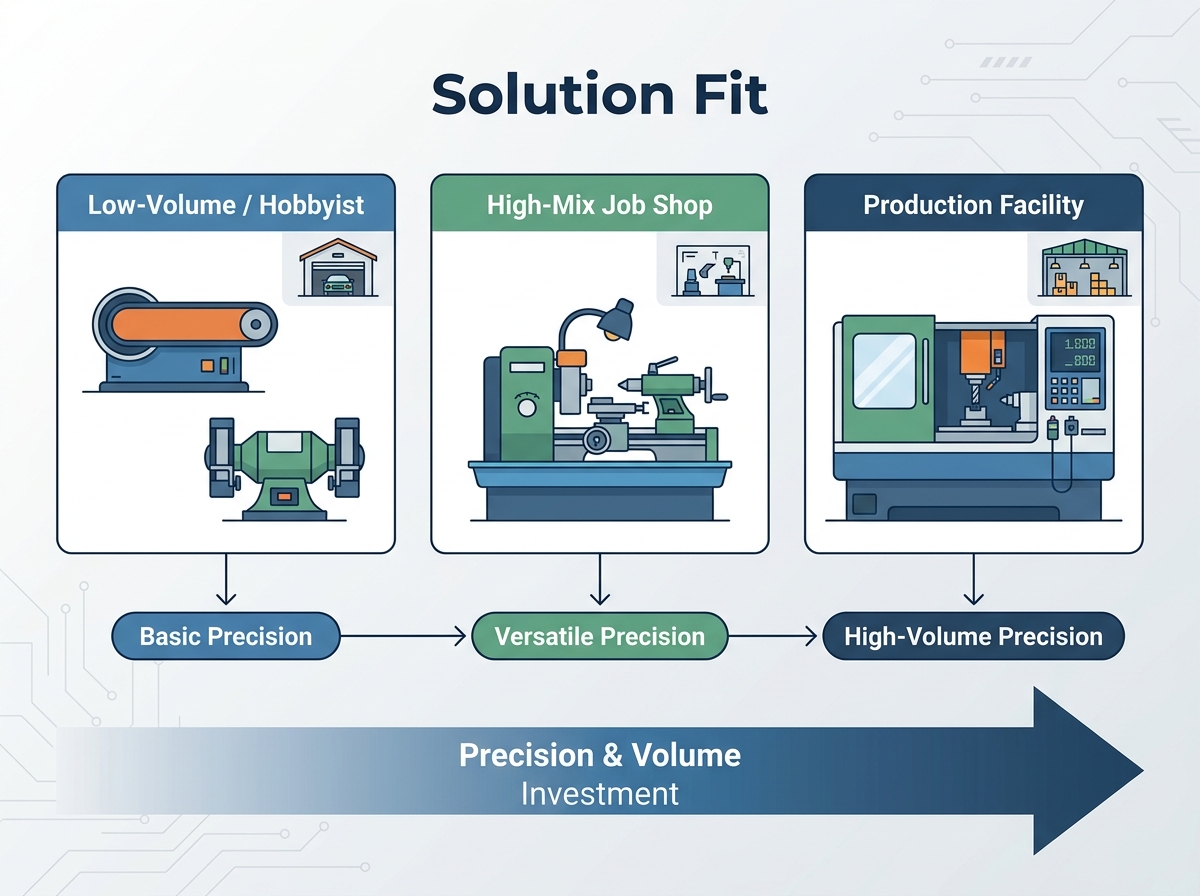
Not every shop needs the same level of grinding equipment. You must evaluate the different tiers of machinery available. Each category serves a specific operational environment and precision requirement.
These machines represent the top tier of tool sharpening technology. They feature high-precision, multi-axis control systems. They handle complex geometries effortlessly, including helical flutes and compound angles. Enterprise environments rely on them heavily. They excel at sharpening specialized or custom tooling. You get extreme accuracy and unmatched repeatability. However, they require dedicated floor space and significant capital investment. Operators also need specialized training to master their complex setups.
These machines serve as the workhorses of the machining industry. They feature highly rigid, adjustable tool rests. They also include built-in coolant trays to manage heat. They represent the gold standard for general shop maintenance. Operators use them constantly for quick touch-ups on HSS and brazed carbide bits. They balance cost, footprint, and performance beautifully. Most job shops find these machines hit the sweet spot for daily operations.
Many shops attempt to use alternative methods to save money. You must understand their severe limitations.
Buying the right grinder requires looking past basic motor specifications. You must evaluate the structural and mechanical components. These elements directly affect the quality of your sharpened tools.
Your machine must support various abrasive types to handle different materials. Aluminum Oxide wheels work best for shaping HSS tools. Silicon Carbide handles non-ferrous materials and carbide roughing tasks. Diamond or CBN (Cubic Boron Nitride) wheels remain mandatory for precision carbide finishing. Ensure the machine utilizes standard arbor sizes. Standard arbors guarantee robust aftermarket wheel availability. Proprietary arbor sizes trap you into expensive vendor ecosystems. You want the freedom to source abrasives from multiple suppliers.
Flex in the system destroys edge precision. Zero-flex tool rests guarantee accurate compound angles every time. You need clear, legible protractor guides built into the rests. They help operators set side rake, back rake, and relief angles perfectly. A rigid rest ensures the tool stays firmly planted during heavy passes. The operator focuses entirely on the grind. They never waste energy fighting the machine's vibration.
Spindle runout causes the wheel to hop during rotation. Wheel hop leaves faceted, uneven finishes on the cutting edge. Strict spindle runout tolerances remain non-negotiable for high-quality finishing. Consider the drive systems carefully. Direct-drive motors offer mechanical simplicity and fewer moving parts. Belt-driven systems often provide superior torque multiplication at low RPMs. High torque prevents the wheel from bogging down during aggressive material removal.
Heat destroys tool temper rapidly. HSS turns blue and softens instantly when overheated. Integrated mist systems cool the contact zone effectively. Flood coolant systems offer maximum thermal management for continuous grinding. Keeping the tool cool preserves its essential hardness. Managing heat ensures the newly ground edge lasts through demanding turning cycles. Never quench a hot carbide tool in water, as thermal shock causes micro-fractures.
Installing the machine only solves half the puzzle. You must address the daily operational realities. Ignoring these risks leads to poor tool life and potential safety hazards.
Grinding wheels do not stay perfectly flat forever. They develop grooves and load up with metal particles over time. Diamond dressers flatten the wheel face and restore its geometry. They also expose fresh, sharp abrasive grains. Dressing takes time away from production. It represents a hidden operational cost you must account for. You must train operators to dress wheels regularly. A glazed wheel burns tools instead of cutting them cleanly.
Grinding generates hazardous airborne dust continuously. Carbide dust contains cobalt, which poses severe respiratory risks upon inhalation. Abrasive particles also damage nearby machinery ways if left unchecked. You must capture this dust at the source. Integrate your grinder firmly into a central shop vacuum system. Alternatively, utilize wet-grind setups to trap dust in the coolant flow. Strict compliance with safety standards protects your team and your equipment.
Grinding single-point tools involves a steep learning curve. Novice operators often burn tools or grind incorrect relief angles. You must standardize your angle templates across the entire shop. Provide brass gauges or 3D-printed templates at the grinding station. This eliminates dangerous guesswork entirely. It removes your dependency on localized tribal knowledge. Proper, documented training guarantees consistent results across all operator shifts.
You must align the equipment with your production environment. Overbuying wastes capital, while underbuying creates frustrating bottlenecks.
Review the following breakdown to determine which setup matches your daily operational demands.
| Shop Environment | Primary Need | Recommended Solution | Key Features to Target |
|---|---|---|---|
| High-Mix, Low-Volume | Versatility & Speed | Dedicated Bench-Mounted Grinder | Quick-adjust rests, dual-wheel setup (coarse/fine). |
| Production Machining | Consistency & Automation | Universal Tool & Cutter Grinder | Automated indexing, DRO, enclosed coolant. |
| Maintenance / Enthusiast | Budget & Basic Function | Modified Bench Grinder / Attachments | Slow-speed motors, aftermarket rigid rests. |
Job shops see different materials and profiles daily. They need extreme versatility above all else. Prioritize versatile bench tool grinders for these environments. Look for quick-adjust rests that save valuable setup time. Dual-wheel setups offer immense flexibility here. You mount a coarse wheel on one side for roughing. You mount a fine diamond wheel on the other for finishing. This keeps the workflow moving quickly.
High production volume demands absolute durability and speed. Evaluate universal tool grinders for these demanding facilities. Look for automated indexing features that speed up batch processing. Digital readouts (DRO) ensure exact positioning for critical tolerances. Enclosed coolant systems remain a must for high-volume work. They keep the shop floor clean and manage intense heat generation safely.
Budget constraints often dictate equipment choices here. Consider specialized attachments for existing machinery first. Dedicated slow-speed grinders also work very well in these settings. They balance low acquisition costs with acceptable precision. Slow-speed motors prevent accidental overheating of tools by novice users. They handle occasional sharpening tasks without requiring massive capital investment.
A properly specified grinder directly boosts your overall machining efficiency. It eliminates vendor wait times and ensures your cutters always perform optimally. Moving away from reactive tool replacement saves significant capital over time. It gives your operators the autonomy to keep production running smoothly.
To begin your evaluation process effectively, follow these critical steps:
Do not let dull tooling dictate your production schedule. Take control of your edge quality today. Review the technical specifications of your shortlisted machines carefully, and demand proof of rigidity from the manufacturer.
A: Yes, but only with significant modifications. Standard grinders lack the rigid, adjustable tool rests necessary for precise geometry. They also typically include wheels unsuitable for carbide. You must upgrade the tool rest and install appropriate abrasive wheels. Without these changes, you risk ruining the tool temper and creating inconsistent edges.
A: They require different abrasives and thermal management strategies. Grind HSS using Aluminum Oxide wheels, applying coolant carefully to prevent losing its temper. Grind carbide using Silicon Carbide for roughing and Diamond wheels for finishing. Carbide is brittle and prone to thermal shock, so never quench a hot carbide tool in water.
A: Belt sanders offer fast material removal and operate cooler than standard wheels. This reduces the risk of burning the tool. However, they lack the structural rigidity required for micro-precision. They work well for roughing out basic shapes but fall short when establishing precise finishing edges on single-point tools.
A: You must dress the wheel whenever it becomes glazed, loaded with metal particles, or loses its flat profile. High material removal rates dictate more frequent dressing. If the wheel starts burning the tool instead of cutting efficiently, or if you feel vibration from an out-of-round profile, dress it immediately.

