

Views: 0 Author: Site Editor Publish Time: 2026-08-31 Origin: Site
Stop throwing away dull tooling. Discarding worn drill bits creates a massive hidden expense for modern machine shops. You lose money every time an operator tosses a dull tool into the scrap bin. We know you need high-precision cutting tools to maintain production quality. A Drill Bit Grinder solves this problem directly. We define it as specialized equipment designed to restore precise cutting edges and point angles of worn high-speed steel (HSS), cobalt, and carbide bits. Evaluating this machinery requires looking past basic functionality. You must assess volume thresholds, precision requirements, and operator skill levels before buying. We will explore how to categorize different machines and evaluate wheel compatibility. You will learn how to implement a successful resharpening program and choose the right equipment for your specific fabrication needs.
Machine shops burn through cutting tools daily. Dull tools slow down production pipelines. They cause poor surface finishes on workpieces. They also increase the mechanical load on your drill presses and CNC spindles. A Drill Bit Grinder steps in to solve these structural issues. You use it to completely remanufacture the cutting face of the tool.
What does this machine actually do during operation? It carefully removes worn metal from the tip of your tool. First, it restores the primary relief angle. This angle allows the cutting lip to enter the metal freely. Next, it grinds the secondary clearance. This specific step ensures the heel of the drill does not drag against the workpiece. Finally, it reshapes the chisel edge. The chisel edge sits directly at the dead center of the drill point. A properly restored chisel edge penetrates metal efficiently and prevents the drill bit from wandering.
You must clearly define what a successful grind looks like. First, you need perfectly symmetrical lips. Both cutting edges must share the exact same length and angle. If they remain unequal, one lip does all the heavy cutting work. This causes the drill to wander off-center. It also creates an oversized, inaccurate hole. Second, you must maintain correct web thickness. A web running too thick requires extreme thrust force to cut. Third, you want zero thermal damage. Overheating the bit during grinding ruins its metallurgical heat treatment. The tool will fail instantly during its next production run.
When should your business stop discarding bits? You need a clear cost-to-benefit threshold. Look at your daily tooling consumption. Small carbon steel bits often cost mere pennies. You should probably just replace them. However, high-speed steel (HSS), cobalt, and solid carbide bits cost significantly more. If your shop consumes a high volume of bits over 1/4 inch (6mm) in diameter, you hit the threshold quickly. Grinding these larger, expensive tools internally saves massive amounts of operating capital over a single quarter.
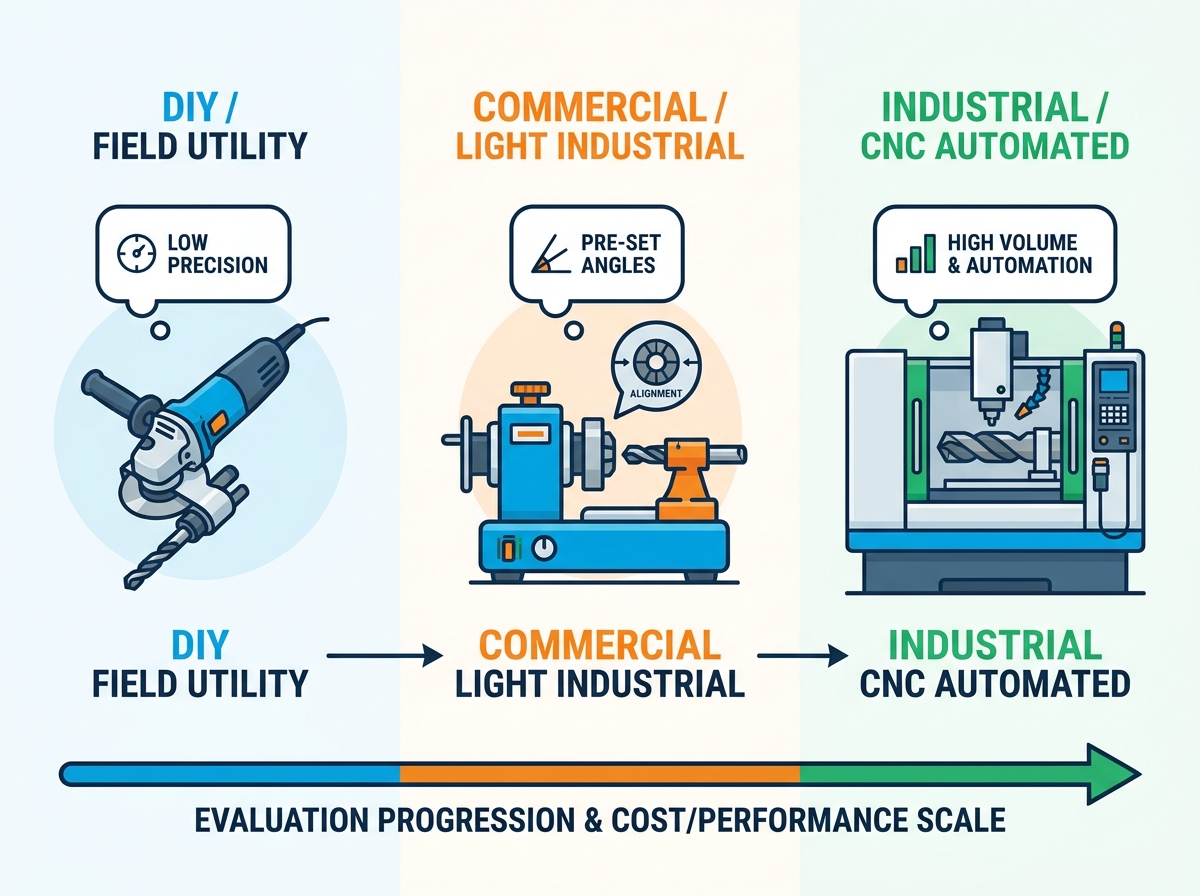
Buyers face a flooded industrial market. You will find equipment ranging from cheap attachments to massive automated grinding centers. We can categorize these solutions into three distinct tiers. You must match the tier to your operational reality.
| Category Level | Typical Application | Precision & Tolerance | Automation Level |
|---|---|---|---|
| Handheld Attachments | Field utility, DIY repairs | Very Low | Strictly Manual |
| Benchtop Grinders | Machine shops, fabrication floors | High | Semi-Automated Alignment |
| CNC Tool Grinders | Heavy industrial, mass volume | Sub-Micron | Fully Automated |
Handheld and angle grinder attachments serve the DIY and field utility markets. You use them for emergency field repairs. They handle low-stakes metalworking projects. However, they carry severe operational limitations. You face an extremely high risk of operator error. Handheld jigs typically produce asymmetrical grinds. They also fail to reliably reproduce complex geometries like split points. Professional machinist communities heavily criticize these tools. They rarely belong in a serious commercial setting.
Dedicated benchtop manual grinders dominate the commercial and light industrial sectors. Machine shops and fabrication floors rely on them daily. They handle moderate to high bit turnover perfectly. These units feature specialized mechanical controls. They use pre-set collets and precision alignment ports. These ports mechanically guarantee correct point angles. Operators easily switch between standard 118-degree and 135-degree configurations. The machine controls the geometry. This effectively eliminates guesswork.
Automated or CNC tool grinders serve heavy industrial applications. High-volume manufacturing facilities absolutely require them. They handle custom tool geometries and heavy solid carbide regrinding. These massive machines boast highly advanced features. They utilize programmable axes. They feature integrated liquid coolant systems to prevent thermal shock. Furthermore, they offer multi-tool capability. You can grind drills, end mills, and precision taps on the exact same machine.
You must evaluate machines against your specific shop requirements. Do not buy based on brand names alone. Focus heavily on these three primary technical pillars.
You must follow the strict rule of grinding wheel pairing. If you ignore this rule, you destroy your tooling instantly. You must use CBN (Cubic Boron Nitride) wheels for High-Speed Steel (HSS) and Cobalt bits. CBN handles the high carbon content of these metals perfectly. Conversely, you must use Diamond wheels exclusively for solid Carbide bits.
We must highlight the severe risk of using the wrong wheel. If you run a carbide bit on a CBN wheel, the wheel glazes over. It stops cutting and generates massive friction. If you run HSS on a diamond wheel, the chemical reaction degrades the diamond rapidly. In both scenarios, you risk severe thermal cracking of the drill bit. You compromise shop safety.
You need to evaluate whether a grinder uses fixed angles or adjustable parameters. Basic models often lock you into a single 118-degree angle. This setup works fine for mild steel. However, modern manufacturing requires extreme versatility.
You must prioritize a "split point" capability. A split point involves careful web thinning at the center of the drill. This geometry prevents the drill from walking across harder materials during the initial plunge. It significantly reduces the thrust required by your drill press or operator. Split point capability remains a non-negotiable feature for serious fabrication. Ensure your shortlisted machine executes this geometry flawlessly.
Grinders face strict physical limitations. They are entirely bound by their included collet sets. A collet represents the precision sleeve holding the bit securely during the grind. A standard commercial machine might accept sizes from 3mm to 13mm. Heavy-duty versions might span 12mm to 26mm.
Buyers must audit their most frequently used bit sizes before evaluating models. If you buy a small-capacity machine, you leave your most expensive, large-diameter tooling unsharpened. Always verify the maximum and minimum chuck capacities before issuing a purchase order.
Buying the equipment only solves half your problem. You must implement it correctly on the shop floor. Many manufacturers claim their machines act completely "plug-and-play." The reality of operator touch tells a very different story.
The learning curve still exists. Manual benchtop grinders reduce human error significantly. They do not entirely eliminate it. Operators still require a distinct feel for rotational pressure. If an operator pushes the bit too aggressively into the wheel, they burn the tool tip. Training remains mandatory for all shop personnel.
Maintenance and truing represent ongoing daily realities. Grinding wheels function as consumable items. They do not last forever. You need to understand the frequency of wheel dressing and truing. Truing restores the perfect circular profile of the grinding wheel. Dressing exposes fresh cutting abrasives. You must factor replacement wheel costs directly into your operational budget.
Dust mitigation and safety require serious leadership attention. We must cover these environmental realities. Dry grinders generate metallic and abrasive dust rapidly. You need proper particulate extraction systems installed. This becomes exceptionally critical when grinding carbide. Inhaling airborne cobalt and carbide particles poses severe, documented health hazards. You must protect your machinists.
Watch out for these common implementation mistakes:
You understand the technology. You know the mechanical risks. Now you need a structured purchasing process. Follow this straightforward methodology to finalize your equipment choice efficiently.
A drill bit grinder serves as far more than just a simple sharpening tool. It acts as a powerful supply-chain stabilizer for busy machine shops. When you control your tooling maintenance internally, you eliminate external shipping delays. You stop relying on expensive third-party sharpening services. You guarantee your machinists always have sharp, precise instruments ready for immediate production use.
You need to take proactive action today. Walk out to your shop floor and audit your scrap bin of dull bits. Calculate the replacement value of that discarded metal. This simple physical exercise reveals your potential immediate ROI. Once you understand the financial upside, browse specific benchtop or industrial models. Match the machine's specific capacity to your shop's actual consumption volume. Invest intelligently in the right equipment and finally reclaim your lost tooling budget.
A: Yes, but it requires decades of machinist experience to manually eyeball the 59-degree half-angle and correct relief. Dedicated drill bit grinders remove human error and guarantee symmetry.
A: Varies by usage, but typically yields hundreds to thousands of grinds if the operator avoids excessive force and thermal damage.
A: Most standard drill bit grinders are calibrated specifically for metalworking twist drills. Masonry (carbide-tipped) and wood (brad point) bits require entirely different geometries and specialized fixtures.
A: Rarely. The time labor cost to align and grind micro-bits usually exceeds their replacement cost, and standard collets often cannot securely grip them.

